The Shuttlecock Is Changing
Synthetic feathers are moving from training courts into real international competition. For decades, natural feather shuttlecocks have defined competitive badminton. But in 2026, synthetic-feather technology crossed an important line.
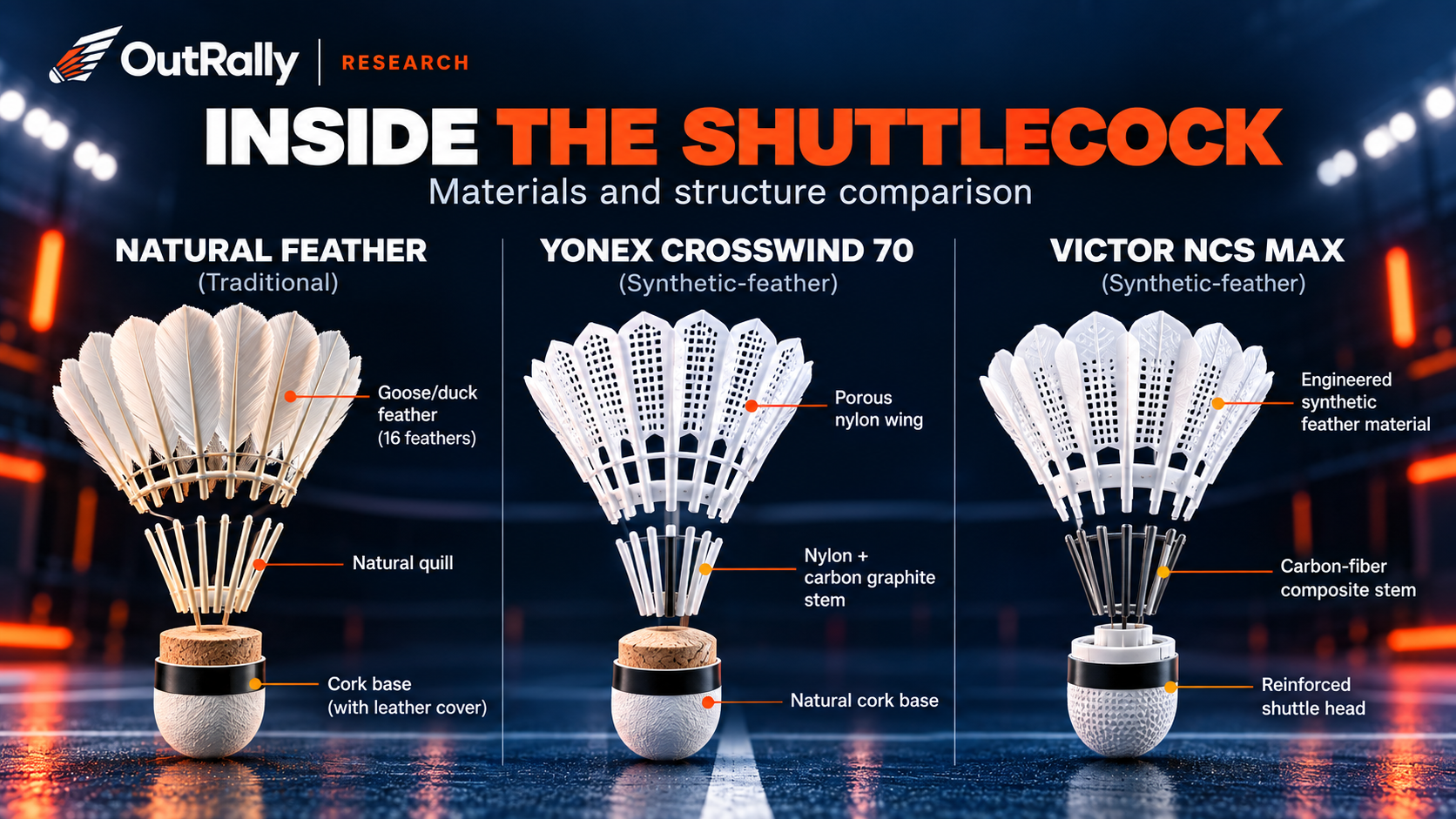
BWF approved VICTOR NCS Max and YONEX CROSSWIND 70 for selected Grade 3 and Junior International tournaments. These are not the traditional nylon shuttles many players associate with school gyms. They are engineered specifically to reproduce the flight and feel of natural feathers while improving durability and supply consistency.
That matters because badminton has a shuttle problem.
Natural competition shuttles depend heavily on duck and goose feathers. Supply fluctuations, rising raw-material costs and growing global demand have pushed shuttle prices higher. For clubs, academies and tournament organizers, shuttlecocks are not a small expense—they are a recurring operating cost.
Synthetic-feather designs are trying to change that equation.
YONEX’s CROSSWIND 70 uses an engineered porous nylon wing, a carbon-reinforced stem and a natural cork base. VICTOR’s NCS Max uses synthetic feather structures with carbon-based support designed to improve stability and durability.
Both products are now being tested in real competition environments.
That does not mean natural feather shuttles are disappearing. BWF World Tour events and top-level international badminton still rely on traditional feather shuttles. The current phase is better understood as a large-scale test: can synthetic products perform closely enough to natural feathers while lasting longer and reducing cost? The most likely future may not be one shuttle replacing the other.
Instead, badminton could develop a more segmented market: premium natural feathers for elite competition, while synthetic-feather shuttles gain ground in junior events, club training, academies, leagues and lower-tier international tournaments.
For OutRally, the key question is simple:
Can synthetic shuttles lower the cost of playing badminton without changing what badminton feels like? If the answer becomes yes, this could be one of the most important equipment shifts in the sport in decades.
What OutRally is watching
BWF approval at higher tournament levels, player feedback, real-world durability, cost per hour of play, and whether clubs and national associations begin adopting synthetic shuttles at scale.
The feather shuttlecock is not disappearing. But for the first time in years, it has a serious technological challenger.